Archive
South Africa 2011: Kruger National Park Photo Report 2 – The Birds
On our self-drive safari adventure in Kruger National Park (see previous entry on the “Big Five” here) we were amazed at the sheer variety and exoticism of the birds we saw. Apparently over 400 species (resident and migratory) call Kruger home, at least for part of the year. The park is really well set-up for birdwatching, with many hides set up next to waterholes and so on, and while I would not in any way call myself a twitcher, I did at least take an interest in what birds crossed paths with me, which is more than I can say at other times in my life.
In any event, we were lucky enough to encounter these fellows during our time in Kruger:

Scops Owl

Common/Steppe Buzzard

Goliath Heron

Cape Glossy Starling

Southern Masked Weaver

Southern Ground-Hornbill with Scorpion

Common Bulbul in a Bird Bath

Lilac Breasted Roller

Martial Eagle in Flight

Crested Barbet

Guinea Fowl
A few more bird shots can be found on my Flickr set here.
Next up: some more of the fantastic creatures lurking around the Kruger…
South Africa 2011: Kruger National Park Photo Report 1 – “The Big Five”
Following on from our brilliant time exploring Cape Town and its beautiful surroundings, we hopped a plane to Johannesburg, picked up our soon-to-be-abused rental car (a miniscule VW Polo we nicknamed “Egbert”) and headed west-northwest towards the Kruger National Park. What attracted us to Kruger was not only its reputation as a game-spotters paradise or its size (think Wales), but primarily we liked the sound of a self-drive safari. Yes, that’s right, instead of having to squeeze into a ruggedized Land Rover with ten random fat tourists, we were free to explore the park and get up close to the animals as we saw fit. As a photographer this is a blessing. Of course, next time I would have chosen a slightly bigger / higher car, but I still preferred it to being subject to the whims of over-excitable children (“LOOK! AN IMPALA!” for the 80th time) or, worse…. birders. 🙂
“THE BIG FIVE”
Ever since Victorian times, there have been five animals in Southern Africa which have been known by this collective moniker. This is not because these are the five biggest species around – no, it’s because, back in Victorian times, these were the five animals most likely to turn around and make a run at you if you missed them with your first shot. We managed to see four of the Big Five, only missing out on seeing leopards, who are very elusive at the best of times, but in the 35-42C heat we experienced (early November) the leopards were well-nigh invisible. But we had many, many consolation prizes…
Lion
As mentioned above, the daytime heat, even in early morning / late afternoon, was pretty staggering – so the lions we saw were generally interested in one thing only: sitting around and panting. This had plus points and minus points. The minus point was the obvious lack of “action” shots. The plus point was that, once you worked your way through the scrum of cars angling for a look, it was generally safe to stick your lens out the window from a distance of down to 10 feet / 3m and shoot away without fear of losing a limb. So, out of a wide variety of sitting-around-and-panting shots I have chosen these three:


Adult Male Lion (who was just sitting outside the gate at Skukuza Camp….)
Buffalo
I have to be frank here and say that, despite their fearsome Victorian reputation, I did not find the African Buffalo to be particularly captivating. I suppose they must suffer a lot for this, as many people can name four out of the Big Five and then stall when trying to remember the poor old buffalo…


Rhino
One of the first encounters we had with a rhinoceros was at close range, as it was ambling along the side of the road, grazing on the fresh green grass to be found there. We were one of only a couple of vehicles and for a time we were able to almost idle alongside it and snap away. It might have been the heat, but almost every time we saw the rhinos I did not feel the slightest hint of threat. It was great as well to get up close to a creature that has essentially not changed for millions of years. Our only regret was that we only saw white rhinos, not the much rarer black rhino.


Elephants
Elephants were byt far the most numerous of the Big Five we encountered, which was lucky as we were so enamoured of them. They are the real deal, by turns majestic, powerful, slightly menacing, and – would you believe it – playful. Once we got over our initial nervousness of how to manoever around the big bulls (in short: do what they want and be ready to run like hell) we really got to enjoy just sitting and watching these giants do their thing, which is primarily running ravage over the countryside, leaving a trail of shredded, snapped and denuded trees in their wake. And you haven’t lived till you’ve been in the middle of a herd of 30-40 elephants as they cross the road in front of and behind your car…
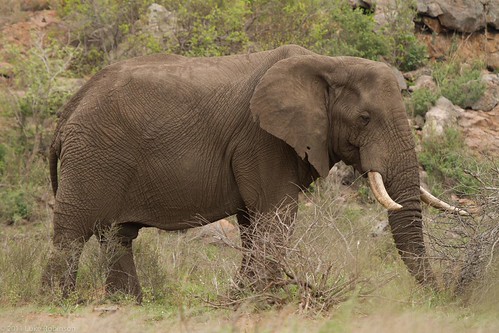


We were very happy to see quite a few instances of play-fighting by the younger elephants, usually in and around the water. On our last day, when three separate herds totalling over 70 animals had shown up at a watering hole below our picnic spot, we watched amused as the elephants played tug-of-war with their trunks, splashed about in the mud, and in one instance, even cheekily mock-charged a pod of hippos hanging out nearby.


More Shots from my Big Five collection may be seen here.
Next installation of photos from Kruger will be…. birds. After that I will move onto some other critters we encountered on our safari. Stay tuned!
South Africa 2011: Photo Report from Cape Town
I’ve been clocking up the miles lately. For most of October I was away with work, first in Dubai, then Turkey, and finishing up in South Africa. Fortunately, when my work was done in South Africa, I was able to kick back and relax a bit, and Nicola flew down to join me for a 10-day trip combining a bit of a a sun-and-fun city break in Cape Town with a magical 5 day safari drive through the Kruger National Park up on the borders of Mozambique / Zimbabwe. But I am getting ahead of myself…
CAPE TOWN
We started out in Cape Town, a fascinating city with much to recommend it: from the amazing geography of the place – all views dominated by Table Mountain looming above – to the diverse and vibrant population (somehow not bitter after all their potted history), it was a great start to our trip. And the Capetonians sure know how to eat, drink and be merry. We based ourselves just on the other side of the mountain from downtown, in a swish beach resort suburb called Camps Bay. From our 1 bedroom flat overlooking the ocean we set out each day to get to know the town and the surrounding area, including the Winelands, the Cape Point, the Kirstenbosch gardens and of course Table Mountain itself. We had very full days punctuated by some of the finest meals we’ve had in ages. A great start to the trip.
Around Cape Town

Houses of Bo Kaap

The Victoria & Albert Waterfront

The Victoria & Albert Waterfront
Camps Bay

Camps Bay and Table Mountain (Panoramic) – click here to view this in a large format

Boy on the Rocks, Camps Bay

Camps Bay and the Twelve Apostles

Sunset on Camps Bay Shoreline
Kirstenbosch and the Winelands

Kirstenbosch Gardens

Kirstenbosch Gardens

Kirstenbosch Gardens

Franschoek Countryside

Franschoek Countryside

School Bus, Franschoek Countryside
The Cape Peninsula and False Bay

The Cape of Good Hope

Cape Point Lighthouse

Cape Point

Ostrich at Cape Point
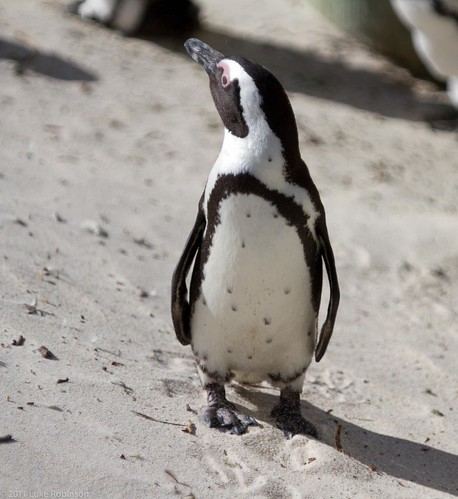
Penguin at Boulder Beach, Simon’s Town

Beach Huts at Fish Hoek

40 Winks, Fish Hoek

Surf off of Hermanus
Table Mountain

Table Mountain Cable Car

Abseiling Table Mountain

Top of the World

Atop Table Mountain

Fynbos Flowers on slope of Table Mountain

Cape Town from Table Mountain (Panoramic) – click here to view this in a large format
Of course, these and other Cape Town shots can be found over in my Flickr set here.
Stay tuned – in the not too distant future, I will post select shots from the second half of our trip – our safari through the Kruger National Park…
Photos from Barcelona and Alt Emporda
As a once-resident of Barcelona I return from time to time to reacquaint myself with the city and with my good friends who still live there. We were able to have a small visit last month and enjoyed sauntering around the Barrio Gotico and Barceloneta, including a visit to my favourite cava bar, Can Pejano.


After a few days we moved on to the countryside, to a tiny village called Montiro in the Catalan area of Alt Emporda, where a friend’s family had a welcoming holiday home. Montiro is surrounded by lovely apple orchards and fields of straw grass, rolled up into bales.


Vietnam Trip Photo Report #4: Huế and Sapa
In an effort to speed up my faltering photo posting progress from this trip (which was finished over a month ago, mind) I am combining two cities into one post again even though they are miles apart, both in terms of disposition and in terms of geography.
Huế
We were led to believe by a couple of people that Huế was the less touristic, more “authentic” and historically significant alternative to Hội An, but I would be the first to admit that we struggled there. Despite staying in an excellent hotel, we found the actual city to be imposingly big and hostile to pedestrians, with some of the most persistently annoying cyclo touts (I recall beginning to wince at the approaching shout of “HELLO!”) and moto drivers around. It didn’t help matters that on the first day we slogged through a couple of miles of this annoyance to cross the river to the Imperial Citadel in oppressive jungle heat. Think Adrian Cronauer’s forecast of “continued hot and shitty” and you’re there.
But we got to the Imperial City and the Forbidden City within and were impressed by the old buildings and the new – some of them restored to former glories after pesky bombings by the Americans in the 60s. We chanced some fairly dodgy street food (congealed pig’s blood, anyone) and dodged yet more cyclo drivers. On the second day we battled through small intestinal distress and retook the city, this time on a smarter conveyance: bicycles. This was a much more pleasant way to see the city as it precluded the cyclo touts approaching and also cut the city down to a manageable size, allowing us to get around to the central market and the surrounding canals.


Sapa
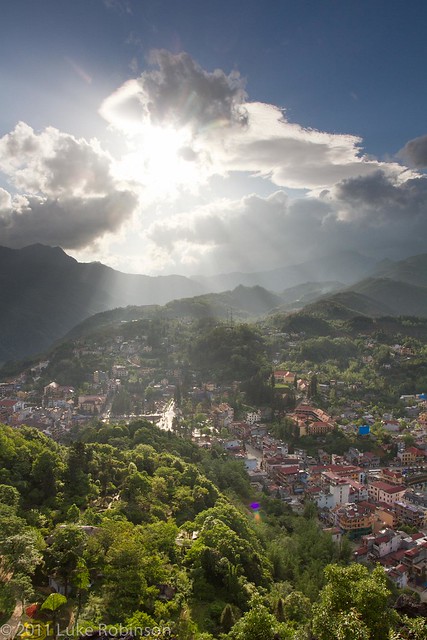
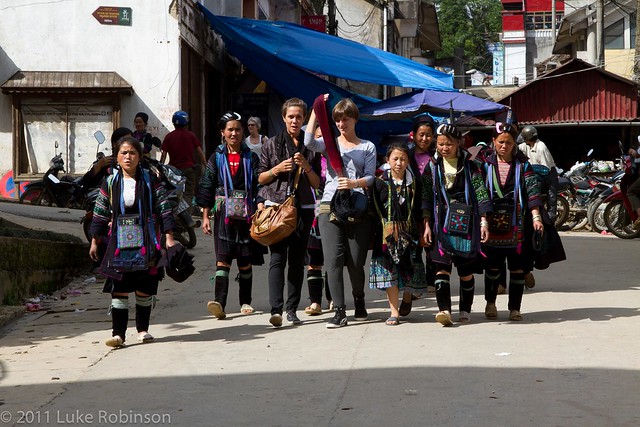
Half a country away on the Chinese border is the former hill station of Sapa. Whereas we had been wrongfully advised of Huế’s “authenticity” and lack of tourists, several fellow travelers had shared horror stories of the tenacious hill tribe touts of Sapa, so we arrived expecting the worst. As it turned out, aside from an initial encounter with a gaggle of Black H’mong women swarming our bus on arrival, and a bit of a rip-off tour booked from our hotel, most of our time in Sapa was copacetic and we found Sapa quite relaxing even as it was touristic.
Our time in Sapa was mostly visiting the surrounding countryside of steep rice terraces, villages, parks, and the odd waterfall. It was on one of our excursions over into the village of Cat Cat that I decided to lay down on my back to get a beauty shot of a water buffalo and did my back in, a condition that has only exacerbated over time and is still affecting me over a month later as I type this in Nigeria. But we continued with our hike and our overall experience of Sapa was a positive one which made me want to come back and get a bit more off the beaten track next time.




I couldn’t resist including the shot below, which I forgot I had captured. These two German girls were the two biggest marks in Sapa, by which I mean that they had developed no defenses against people approaching them on the street. Every time a H’mong woman came up to them, for instance, they would stop and chat and check out whatever she was selling. Except that this always drew a crowd of other H’mong merchants, so that wherever these girls went, they always had a convoy of hill tribe women attached like lampreys.
That’s all from Sapa, well of course apart from the rest of the photos over on Flickr (and more photos from Huế to boot).
We are into the home stretch now, in the next post or two we will cover the buzzing capital of Vietnam, Hanoi, as well as the beautiful karst wonderland of Ha Long Bay. By which point I will well and truly be ready to change tack onto other destinations… Barcelona awaits.
Vietnam Trip Photo Report #3: Hội An
My last trip report had us heading north up the coast for a bit of seaside relaxation. After this, we cheated a little bit and hopped on a plane up to Hội An, a ridiculously charming (and deservedly touristic) French colonial town about halfway up the coast towards Hanoi.
We had approached Hoi An with caution due to its reputation as a tourist trap, but we were in luck as it was Reunification Day holiday weekeend, which meant that the sheer numbers of Vietnamese tourists meant that we didn’t feel like Hội An was some sort of theme park for Western tourists. We had a blast in our three days there, and managed to hook up with some friends who were heading in the other direction.
Hội An is a small town, easily walkable, with a charmingly down-at-heel look about it (my folks would have called it “elegantly shabby”). It was generally a friendly town, with a great deal going for it on the food scene, and a lot of history to trawl through. There was also a great central food market. We had day trips out to the Cham temple ruins in My Son as well as some very scenic beaches and outlying villages surrounded by rice paddies.
As it happened I found Hội An extremely photogenic and came away with over 700 photos of the place. Clearly I will not be subjecting anyone to the full 700, but I still uploaded a bulging set of 50 of my favourite Hội An shots to Flickr. I present a selection of my favourites below but I highly recommend a browse of the other photos over on Flickr.


Next time around: The imperial city of Hue. Then onwards to Hanoi, Sapa and Ha Long Bay…
Vietnam Trip Photo Report #1: Saigon
I’m back baby, this time with another collection of interesting (to me) photos collected on yet another jaunt overseas, this time to sunny / ridiculously-hot Vietnam for a three-week south-to-north journey starting in Saigon and ending in Hanoi. I didn’t post as I went along during the trip, mostly because I was shooting almost entirely in RAW and had only an iPad and no means to develop them on the road, nor was the internet connection ever particularly impressive there.
But the upshot is that I’ve got 5000 photos to edit down and develop, and rather than wait till I am done with the lot, I am going to break the trip up and post as I go, in chronological order. As it happens, due to the vagaries of my job I am actually posting this from Dubai, which will be the subject of a future photo report.
Asian Dawn
My first photo was taken before we even got to Vietnam. As we approached Kuala Lumpur in Malaysia, we were presented with a lovely sunrise above the clouds. It was a feast for the eyes.

SAIGON
Saigon (or Ho Chi Minh City if you are strongly communist-leaning) was our first stop on our Vietnamese odyssey and what a way to start – this place was full of life, bustling with a million mopeds, combining Western opulence and architecture with southeast Asian street life. In Vietnam, life is lived on the street, especially once you get onto the back streets. Soup ladies carry entire kitchens on poles over their shoulders, right down to the little plastic stools that are a challenge to Western knees (and balances). Little old ladies peruse fresh herbs being sold right on the pavement, often next to unrefrigerated meat, and little children scamper everywhere, impossibly cute until they decide to pee into the gutter right in front of you.


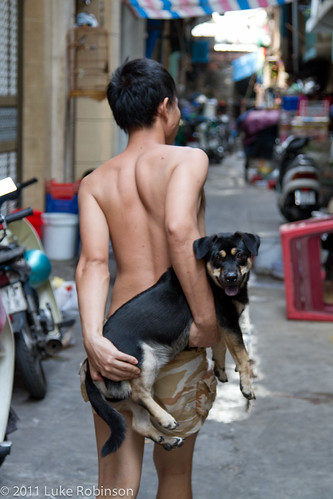

Obligatory Scooter Shots
In every Vietnamese city, Saigon especially, seemingly every square inch of street is filled with revving, beeping scooters (carrying people, families, commercial merchandise, and/or livestock) which thread through and around each other and pedestrians like streamers in a Maypole dance. Visiting Vietnam means quickly working up the necessary courage to cross a seemingly-impenetrable two-way, four-lane road heaving with motorised threat, which is only possible if you do it the way the Vietnamese do: slowly, steadily, and without stopping. Magically, the traffic parts around you, and we learned from watching Vietnamese over time that it is entirely possible (though challenging) to cross a busy two-way road without looking in either direction.


Street Food
Everywhere you look in Vietnam, there is food on the street, whether it be from cafes or streetside restaurants, or from pho places that set up on the same pavement every night, or from the little soup or banana pancake ladies who constantly move around a set of favoured perches, setting up shop the moment the passing foot traffic looks promising…


The Saigon River
We made a day trip out to the Cu Chi Tunnels (quite an experience, if not a photogenic one) and this involved a jaunt on the Saigon River, passing many barges and fishing boats along the way. The Cu Chi Tunnels will be featured on Facebook and possibly a video in the future, but I did want to share the tapestry they had up illustrating the intended use of the traps that used to be laid around the area…


More photos
More photos from Saigon can be found in my Flickr set here.
Next time…
Part 2 of the trip report will be coming in the next two weeks, and will include photos from the coastal towns of Mui Ne and Nha Trang. Part 3 will focus on Hoi An and potentially Hue as well. Then it will be on to Hanoi, Sapa, and Ha Long Bay.
Taster photo from Saigon
More to come…
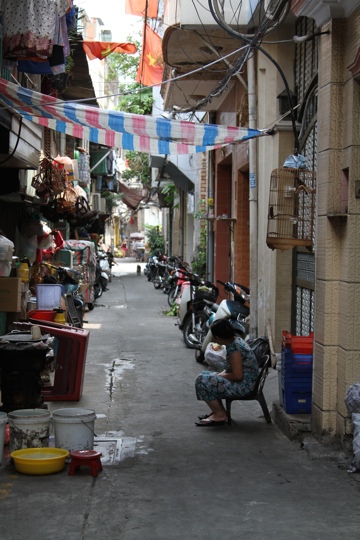
Al Balad (“The Old Town”), Yanbu, Saudi Arabia

New York City in photos – Sept/Oct 2010
After a relaxing few days in Cape Cod, we headed down to New York City, staying 3 nights in Manhattan and 2 nights in Brooklyn with my sister. As it was my girlfriend’s first trip to NYC, we did a whole lot of walking (and a fair bit of eating and drinking, too) – and it was a good excuse to do a couple of touristy things I had never gotten around to doing, such as go up the Top of the Rock.


 Mortal Coil